Push-to-Talk or Get Kicked: The Voice Chat Thunderdome That Forged an Entire Generation
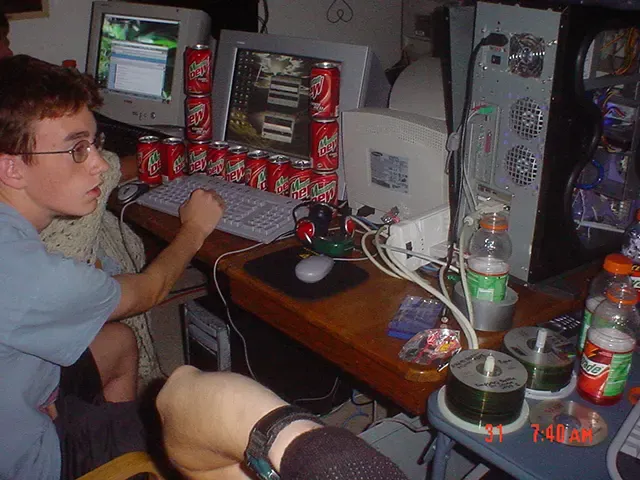
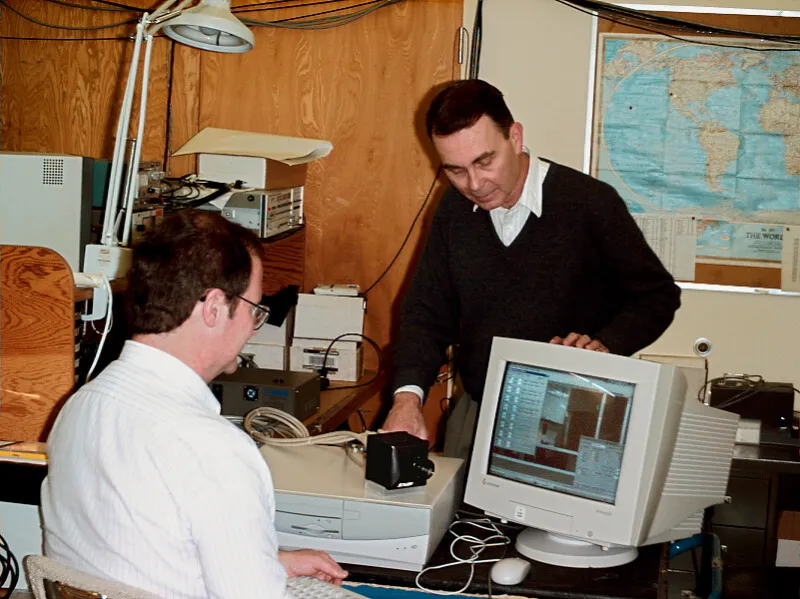
Photo: vintage gaming headset microphone computer setup early 2000s LAN party, via rarehistoricalphotos.com
There is a specific kind of social terror that has no name in any language, but every person who gamed online between 1999 and 2006 felt it: the moment you first pressed the push-to-talk key on a voice server full of people you'd only ever communicated with through text, and heard your own voice come back to you through the speakers, thin and strange and nothing like you'd imagined it sounded. You'd been Wr4ithBl4de for three years. You'd been a force of nature in the Tribes servers. You had a reputation. And now everyone knew you were seventeen and from Ohio and your voice was cracking.
This is the story of early gaming voice chat — a technology that should have been a convenience and instead became a complete social renegotiation of who was allowed to exist in online gaming spaces.
Tribes and the First Chaotic Experiment
The timeline matters here. Starsiege: Tribes, released in 1998 by Dynamix, was doing things with online multiplayer that most developers hadn't attempted yet: large-scale team combat across huge outdoor maps, with skiing mechanics that required actual coordination between players. The problem with coordinating ten people across a large outdoor map is that by the time you've typed "THEY'RE AT THE FLAG STAND COMING FROM YOUR LEFT" the flag stand is gone and so is the flag.
 Photo: Starsiege: Tribes, via androidarts.com
Roger Wilco entered this environment like a very loud, very unstable solution to a problem everyone had agreed to suffer through. Developed by Resounding Technology and released in 1999, Roger Wilco was voice-over-IP software specifically designed for gaming — you ran it alongside your game, assigned a push-to-talk key, and could suddenly hear the people you were playing with. The name was military phonetic alphabet for "Received, Will Comply," which was either a charming bit of thematic consistency or a warning about the kind of authority structures that would develop in these communities, depending on how your experience went.
The audio quality was, charitably, terrible. Roger Wilco on a dial-up connection sounded like someone describing a tactical situation through a tin can telephone while standing next to a running dishwasher. The codec compressed your voice into something that conveyed approximately 60% of the phonemes you'd intended, which meant that "they're coming through the south entrance" could arrive as "they're cunning through the mouse entrance" and result in three of your teammates skiing directly into a cliff.
Nobody cared. It was magic anyway.
The Server Hierarchy Problem (Or: How a Ventrilo Admin Became a Minor Deity)
Here's something that gets forgotten in the romanticization of early gaming communities: voice chat servers required someone to run them, and the person who ran the server had absolute, unappealable power over who got to speak and who got muted into oblivion.
This was not a small thing. In an IRC channel, a ban was annoying but recoverable — you reconnected, you found another server, you moved on. On a clan's Ventrilo server, a ban meant you were effectively expelled from the social community that had formed around that server. Your Counter-Strike team played out of that Ventrilo. Your friends were on that Ventrilo. The weekly movie night that had developed organically in the #general channel happened on that Ventrilo. The admin who'd built the server and paid the fifteen dollars a month for hosting had, through no particular planning, become the landlord of your entire social life.
The admins who handled this power well were genuinely great. The admins who handled it poorly — and there were many, because the kind of person who at age nineteen is paying for a Ventrilo server and managing a fifty-person gaming community is not always the most emotionally regulated individual — created the template for every toxic community manager the internet would subsequently produce. They muted people for personal slights. They created rank structures with custom icons that mapped to real social status. They had girlfriends who got special permissions and ex-girlfriends who got banned. They were, in short, practicing for LinkedIn.
TeamSpeak vs. Ventrilo: The Codec Wars Nobody Asked For
By 2001, the voice chat market had fragmented in the way that all early internet technologies fragmented: multiple incompatible solutions, each with passionate advocates, none of them obviously superior, all of them the subject of arguments that could consume an entire IRC channel for three hours.
TeamSpeak, developed by a German company and initially released in 2001, offered better audio quality than Roger Wilco and a server architecture that scaled more gracefully. Ventrilo, developed by Flagship Industries, competed on a different axis — it had a slightly more polished client, somewhat better codec options, and arrived at a moment when the gaming community was large enough to support real network effects.
The arguments between TeamSpeak and Ventrilo users were, in retrospect, almost entirely about tribal affiliation rather than technical merit. Both programs had their issues. TeamSpeak's early versions had an administrative interface that seemed designed to cause confusion. Ventrilo had codec settings that required actual knowledge of audio engineering to optimize, which meant that most servers sounded either like someone talking through a kazoo or like someone talking through a slightly nicer kazoo.
The Speex codec versus GSM argument was the kind of thing people typed in all caps. "SPEEX IS OBJECTIVELY BETTER FOR VOICE" would be met with "GSM USES LESS BANDWIDTH YOU IDIOT" and then the conversation would spiral into a technical debate that neither party had the actual expertise to resolve, but that both parties pursued with the intensity of a graduate thesis defense. This was the internet in 2002. Every configuration choice was a moral position.
The Social Evolution: When Keyboard Warriors Had to Find Their Voices
The genuinely interesting thing about early voice chat wasn't the technology — it was what the technology did to the people using it.
Online gaming in the pre-voice era had developed a specific kind of persona. You could be whoever you wanted in text. You could project aggression or authority or technical expertise through your typing speed and your choice of words. The handle was the person; the person behind the handle was irrelevant. Tribes servers were full of people who had carefully constructed online identities that bore essentially no relationship to their actual personalities, and this was considered completely normal.
Voice chat broke this arrangement immediately and ruthlessly. The moment you keyed up on a Ventrilo server, everything you'd built evaporated. Your voice revealed your age. It revealed your regional accent — and there was absolutely a hierarchy, with Northeastern and West Coast accents carrying more social capital than Southern or Midwestern ones, because online gaming communities in 2002 were not immune to the broader stupidities of American regional prejudice. Your voice revealed whether you were nervous. It revealed whether you were actually the strategic genius your typing suggested or whether you'd been copying callouts from a Counter-Strike forum.
Some people thrived. The players who'd been good at the game and also happened to be naturally confident communicators became the leaders their clans had been waiting for. But a significant portion of the early online gaming population discovered, with some distress, that their entire identity had been a text-based performance, and that the performance didn't survive contact with a microphone.
The solution some people found was to simply never key up. You joined the Ventrilo server. You listened. You responded to direct questions with the absolute minimum syllables required. You became the ghost in the voice channel, present but inaudible, the person everyone knew was there but had never actually heard. This was considered slightly weird but tolerable, right up until the moment when a critical callout needed to happen and the ghost in the channel just watched it not happen.
The Discord Singularity and What We Lost
Discord, launched in 2015, essentially solved every practical problem that Roger Wilco and TeamSpeak and Ventrilo had been fighting for fifteen years. Persistent channels. Reliable audio. No per-server hosting costs. Easy administration. The adoption curve was nearly vertical.
What Discord also did, by making voice chat frictionless and permanent, was eliminate the specific social texture that had existed when voice was a deliberate choice. On a Ventrilo server, you keyed up because you had something to say. The push-to-talk discipline created a kind of enforced signal-to-noise ratio — you thought before you spoke, because speaking required a physical action, and because the admin would mute you if you breathed too loud.
Discord's always-on voice channels created a different social environment: ambient, persistent, low-stakes in a way that made it both more accessible and somehow less intense than the old Ventrilo experience. The Ventrilo server was a place you went. The Discord voice channel is a place you're perpetually in or out of, and the distinction feels smaller than it is.
Somewhere there are people in their thirties and forties who still remember the first time they keyed up on a Roger Wilco server during a Tribes match and heard their own voice come back to them, strange and human and unavoidably real. They remember the specific quality of silence that followed, while twenty other people processed the fact that Wr4ithBl4de was, in fact, a teenager from Ohio.
And then someone said "nice callout" and everything was fine and they played for four more hours and it was the best night of that entire year.
Push-to-talk, friends. Push-to-talk.