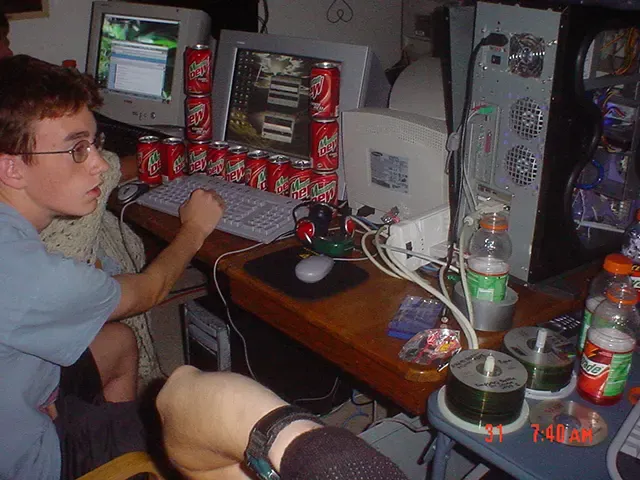
EFnet: The Anarchist Utopia That Collapsed Under the Weight of Its Own IRC Operators
Photo: NOIRLab/NSF/AURA, CC BY 4.0, via Wikimedia Commons
Let's be honest about something: EFnet was never supposed to work. A network with no central authority, no user registration, no enforcement mechanism, no appeals process, and no actual rules beyond whatever the guy with O-line access decided he felt like doing on any given Tuesday — this is not a design document, it's a thought experiment about what happens when you give teenagers global kill commands and no adult supervision.
And yet for a while — a glorious, chaotic, absolutely unhinged while — it was the beating heart of internet culture. Then it became a cautionary tale. Then it became a template that every decentralized platform in the twenty-first century is currently reinventing, apparently without having read the cautionary tale part.
What EFnet Actually Was
The Eris-Free Network got its name from a 1990 split from the original IRC network, EFnet was created specifically to remove a server — eris.berkeley.edu — that its administrators refused to add server-to-server connection limits to. The founding act of EFnet was, in other words, a server ban that the banned party refused to accept. The network was born in conflict. This set the tone.
 Photo: eris.berkeley.edu, via nineplanets.org
By the mid-nineties, EFnet was the dominant IRC network in North America. Hundreds of servers. Hundreds of thousands of users. The channels where warez moved, where hacker culture lived, where you went to get help with your Quake server config or find someone to trade MP3s with — they were on EFnet. The network's size was also its central structural problem, because every one of those servers was independently operated, and the humans operating them were, to put it charitably, not always motivated by the common good.
IRC operators — IRCops — had powers that were genuinely extraordinary by the standards of any other online platform. They could kill connections. They could G-line users, banning them across an entire server. They could issue K-lines. On some server configurations, they could affect the entire network's routing. And there was no HR department, no appeals board, no oversight committee, and no process for removing an IRCop who had decided to use these powers in ways that could generously be described as personal.
The Netsplit as Political Event
A netsplit — the moment when the network's server graph fractures and a chunk of the network loses connectivity to the rest — was technically a routing problem. In practice, it was often a political statement.
The late nineties EFnet netsplits that old-timers still talk about weren't always accidents. When a server administrator had a grievance with another server's administration — over policy, over personal beef, over the kind of disputes that only make sense in the context of a community where your entire identity is tied up in what IRC network you ran — disconnecting from the network was a move. It was the nuclear option, the equivalent of a country walking out of the UN, except the UN had actual rules and EFnet had vibes.
The effect on users was immediate and disorienting. Channels would suddenly show half their population as gone. Bots would lose their ops. Ongoing file transfers through DCC would die. And in the channel, someone would type the dreaded word: netsplit. And everyone would wait, watching the server list in their client, to see which servers came back and which ones didn't.
During a netsplit, channel ops became a contested resource. If the ops were on the disconnected partition when the split happened, the channel on the other partition was suddenly op-less, which was an invitation to a takeover. Channel takeovers during netsplits were so common that entire toolsets were built around timing them correctly. This was not a bug that got fixed. It was a feature of the architecture that persisted for years because the people with the power to fix it were often the same people benefiting from it.
The IRCop Feudal System
The political structure of EFnet, to the extent it had one, was feudal in the precise historical sense. Server administrators owed nominal allegiance to the network as a whole but exercised absolute sovereignty over their own servers. IRCops derived their authority from server admins. Users had no rights that an IRCop was bound to respect.
The people who rose to IRCop status on major EFnet servers were not, as a general rule, selected through any meritocratic process. They were selected through social proximity to the server admin, through demonstrated loyalty, through the kind of political maneuvering that would look familiar to anyone who's read about medieval court dynamics. The result was that IRCop status on a major server was genuinely powerful — it gave you tools to affect the experience of thousands of users — and was held by people whose primary qualification was knowing the right people.
Abuse was not the exception. It was so common that it was practically definitional. IRCops who used G-lines to settle personal disputes. IRCops who granted channel operator status to their friends in contested channels. IRCops who killed connections for users who had annoyed them in channels that had nothing to do with their official role. The IRC operator abuse text files that circulated through the community in the late nineties read like documentation of a systemic problem, because they were.
The channels dedicated to discussing IRCop conduct — there were several, and they were always full — were themselves subject to IRCop interference, because the people being discussed had the tools to interfere with the channels discussing them. The oversight mechanism was also the subject of the oversight. This is not a governance structure. This is a Kafka story.
The Great Splits and What Caused Them
The 1996 EFnet split that produced IRCnet is the ur-example of the network's structural dysfunction made manifest. European server administrators, frustrated with what they saw as US server dominance and unwilling to accept routing policies being pushed from American servers, disconnected. The network that had been building for years fractured along a geographic line that also happened to be a political one.
This was not the last split. It wasn't even close to the last split. The late nineties and early two-thousands were a continuous process of servers leaving, servers being removed, servers rejoining under different terms, and servers being delinked for reasons that the official announcements described in technical language and the IRC gossip described in considerably more colorful terms.
Each split produced the same cycle: outrage from users, technical explanations from server admins that didn't quite explain the timing, counter-explanations from the other side, a period of network instability, and eventually either reconnection or the permanent departure of the split servers to form or join a competing network. DALnet, Undernet, and eventually Freenode all benefited, in various ways, from EFnet's inability to resolve its internal conflicts through any mechanism other than fracture.
The Irony That Web3 Doesn't Want to Hear
Here's the punchline that the current generation of decentralization enthusiasts would prefer you not think about too hard: EFnet failed for exactly the reasons that every serious critic of decentralized governance predicted it would fail. Without a central authority, power doesn't disappear — it distributes unevenly to whoever controls the infrastructure. Without formal rules, norms emerge that benefit the people who were already powerful. Without accountability mechanisms, abuse becomes endemic. Without a way to remove bad actors, bad actors accumulate.
EFnet's founding philosophy — no central authority, no registration, no rules — was genuinely radical and genuinely appealing. It was also genuinely unsustainable at scale, in ways that played out in real time over a decade of increasingly operatic dysfunction.
Every blockchain project, every federated social network, every decentralized platform that launches with a white paper explaining why centralized authority is the problem and decentralization is the solution is running the EFnet experiment again. Some of them will work better than EFnet did. None of them have yet produced a solution to the fundamental problem that EFnet identified and then demonstrated magnificently: when everyone is in charge, the person with the most willingness to abuse their position wins.
EFnet still exists, technically. The servers still run. The channels still have users. The IRCops still have G-lines. The netsplits still happen.
Some things never change. Some things never learn.