The Teenagers Who Buried Every Format: How Warez NFO Files Became the Most Accurate Tech Forecasts of the 1990s
In 1997, a warez release group called — let's say something like DiGiTAL EXPiRY, because they all sounded like that — dropped a cracked copy of some mid-tier business software alongside a .nfo file that ran to about four hundred lines of ASCII-bordered text. Sixty lines were devoted to the usual business: the group's achievements, greetings to allies, a list of groups they had beef with. The remaining three hundred and forty lines were a surprisingly coherent argument that CD-ROM as a distribution format was already dying, that physical retail software was a dead man walking, and that the entire industry was about to get turned inside out by direct download.
Gartner, that same year, published a report suggesting CD-ROM had a robust future ahead of it. The report cost several thousand dollars. The .nfo file was free, buried inside a zip on an FTP server, and it was substantially more correct.
This is the story of the most accidentally accurate technology analysts in internet history.
The NFO as Accidental Journalism
The .nfo file — pronounced 'info,' though some people said 'en-eff-oh' to sound more technical — was, on its surface, a release note. Every scene release came with one: a text document, rendered in Codepage 437 to allow for elaborate ASCII art borders, that described the release, credited the group, and established the release's place in the hierarchy of the scene.
But the NFO was also a platform. And like every platform given to people with strong opinions and no editorial oversight, it rapidly became something more than its original function. Group members — who were, let's be honest, mostly teenagers and early-twenties guys with too much time and a surprising amount of industry awareness — used the NFO's unstructured space to editorialize.
They editorialized about copy protection schemes they had just defeated. They editorialized about software pricing. They editorialized about the record industry's response to MP3s, the movie industry's response to DivX, and the game industry's response to, well, them. And buried in those editorials, written in the flat declarative tone of someone who has already decided they're right, were predictions that held up with uncomfortable consistency.
The Format Obituaries, Ranked by Accuracy
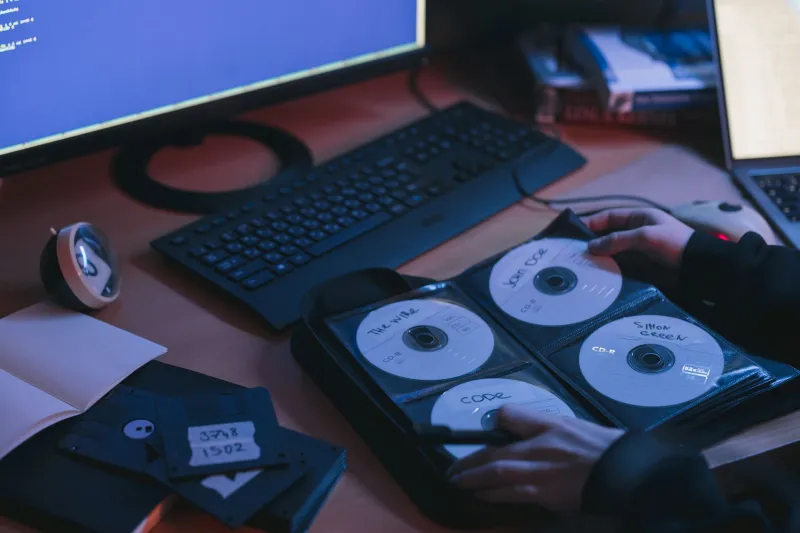
The Floppy Disk: NFO files were writing floppy disk eulogies as early as 1995. When software started shipping on ten, twelve, fifteen floppy disks — when you needed a whole afternoon and a prayer to install something that came on a CD for fifteen dollars less — the scene noticed immediately. The phrasing was usually contemptuous ('why are these idiots still shipping on floppy') but the underlying analysis was correct. Floppy was finished. The industry acknowledged this roughly three years later.
The CD-ROM: More interesting, because the scene had a complicated relationship with the CD. On one hand, it was easier to rip than a cartridge. On the other hand, the scene's own infrastructure — FTP sites, IRC bots, dial-up transfers — was built around the assumption that you could compress a game or program into something transferable. The CD's size was an obstacle. NFO files from the late 1990s are full of complaints about 'CD bloat,' about developers padding installs, about the coming irrelevance of a format that required physical media when the internet existed. The predictions were early. They were also correct.
Physical Software Retail: This one was almost universal. By 1999, you could find NFO files from a dozen different groups all circling the same conclusion: the retail software box was a relic. The logic was self-interested — the scene was already distributing software faster and more cheaply than any store could — but the conclusion was analytically sound. The last major physical software retailers died in the 2010s, roughly on the schedule that a careful reading of late-nineties NFO files would have suggested.
The Scene Itself: The most haunting predictions. Starting around 2001 or 2002, some NFO files began eulogizing the scene's own model. Groups that had spent years perfecting FTP-based distribution started noting, with varying degrees of acceptance, that P2P was changing the economics. That BitTorrent would democratize what the scene had kept elite. That the careful hierarchy — courier, supplier, cracker, group, affiliate site — would dissolve when anyone with a broadband connection could become a distributor. These predictions were precise. They were also, for the groups writing them, a kind of suicide note.
Why Were They Right
The honest answer is that the scene had better incentive alignment than any analyst firm. Gartner was paid by the industries it was analyzing. An analyst who predicted the death of CD-ROM in 1997 was an analyst who lost clients in the software distribution business. There were structural reasons for optimism that had nothing to do with the actual trajectory of the technology.
The scene had no such constraints. The scene's incentive was to understand the landscape as accurately as possible because their operations depended on it. They needed to know which formats were dying because dying formats meant new attack surfaces. They needed to understand distribution economics because they were running a distribution operation. They were, in the purest sense, practitioners.
They were also reading the consumer side directly. Scene members were the heaviest users of every format they were analyzing. They knew before any market researcher that people hated installing software from twelve floppy disks because they had done it themselves, cursed through it, and decided immediately that there had to be a better way.
The Newsletter That Wasn't
There is a direct line — uncomfortable but real — between the NFO file's editorial tradition and the technology newsletter ecosystem that now employs thousands of writers and charges subscription fees that would have seemed insane to anyone in 1998.
The NFO was a newsletter. It had a masthead (the group's ASCII logo), a regular publishing schedule (tied to releases), an editorial voice (contemptuous, confident, occasionally brilliant), and a distribution network (the entire warez scene). It was read by tens of thousands of people who were, by definition, the most technically engaged consumers on the internet.
Substack didn't invent the opinionated technology take. It just figured out how to charge for it. The pirates were giving it away for free, bundled with software that also happened to be free, written by people who had no professional stake in being right and were right anyway.
Somewhere in a directory of old NFO files — and they are out there, archived on sites that the scene's own prophets would have predicted would eventually become the only record of their existence — there is probably a paragraph that accurately describes the format you are reading this on right now.
It was written by a seventeen-year-old who was also, probably, eating cereal at 3 AM and waiting for a 700MB ISO to finish downloading at 4.2 kilobytes per second. He had no idea he was doing journalism. He was right about everything anyway.